Sunlight
Halo Event (2026)
I invited artists Laurence Beaudoin Morin and Kathy Kennedy to work with me to devise a short performance within a strucutre of reflected sunlight set up by Research Assistant Kris Hodder and I using the motorized mirrors developed by Raymond Oppenheimer. The result was a choreographic, materially meditative piece, with sharp engagements with sunlight and a poetic, hauting meditation on Icarus. Funded with a SSHRC Exploraitions Grant via Concordia University. Thanks to QUAI 5160 and their incredible staff. Photos and video by Brooklyn Melnyk.


A piece of paradise (2025)
“A piece of paradise,” a little solar-powered, sun-reflective robot seeking sunlight in a parking lot. From an afternoon of performances and site specific installations on August 23rd, 2025 (“Emprunter Alexandra-Marconi Performances et installations in-situ”) facilitated by Lynn Hughes, Francine Lalonde and Produit Rien.
From Produit Rien:
“Between Marconi Street, the CP train tracks, Saint-Zotique and Jean Talon, there is a neglected but fascinating area that functions as both a recreational space and an informal passageway. This enclave contains magical nooks, including small wooded areas and the railroad line. On the other hand, it also clogs up roads in the neighbourhood and becomes a heat island in summer.
We wondered whether an area that has been abandoned for so long and does not seem to belong to anyone might, in fact, belong to everyone. Could a privately owned, neglected site be re-appropriated and turned into a public space? What purpose might such a space serve, other than as a place to walk through or park cars? How might we preserve the free, untamed qualities of such a space and protect the neighbourhood from the adverse effects of its transformation? Could a few minimal, artistic or urbanistic interventions bring people together and collectively transform the area into more than a series of desire paths? What future do we envision for this space?
The artists and architects participating in this exhibition all have ties to the area—some live and work here, others have lived and worked here in the past, some have been evicted or worry they still might be, and others simply pass through the area regularly. “
Sun Suite (10,000 Years of Peace) (2024)

A workshop performance with reflected sunlight. Raymond Oppenheimer built a series of motors to control light-reflective mirrors. I collaborated with a creative team to explore, program and work with these mirrors in response to Baron Tymas’ piece “10,000 Years of Peace” from his Snow Suite. Performer/Creator Camille Huang improvised with and tested the capacities of the reflected light and movement of the mirrors over a series of rehearsals both indoors with reflected stage light and outdoors in the afternoon sun.
Artistic Director/Producer: Meghan Moe Beitiks
Composer: Baron Tymas
Performer/Creator: Camille Huang
Technical Engineer: Ray Oppenheimer
Board Operator: Kris Hodder
Technical and Moral Support: Pietro Cerone, Christine White
Documentation: Brooklyn Melnyk
Funded by a SSHRC Explore Grant


Angles of Consequence (2023-ongoing)

Based on my previous work with reflected sunlight, I am producing a season of site-specific performances with Canadian performers, inviting them to respond to key sites of climate advocacy and destruction. This project is funded by the Social Sciences and Humanities Council of Canada and is supported by the Performing Arts Research Cluster (LePARC) at the Milieux Institute at Concordia University. More information on the project website.
Pulse: Entanglements of air and light in pandemic academia (2021)
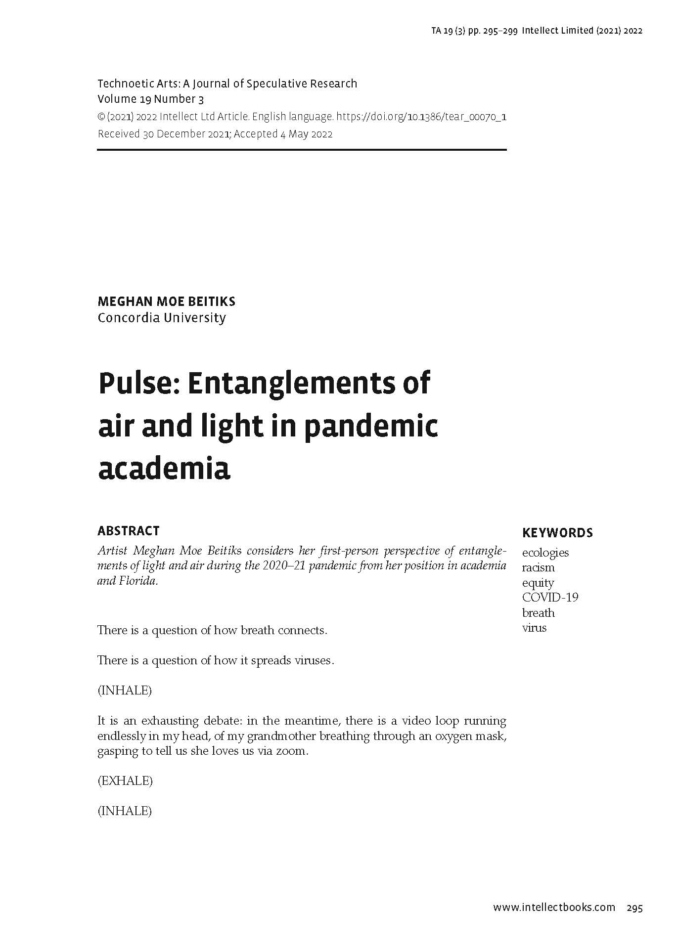
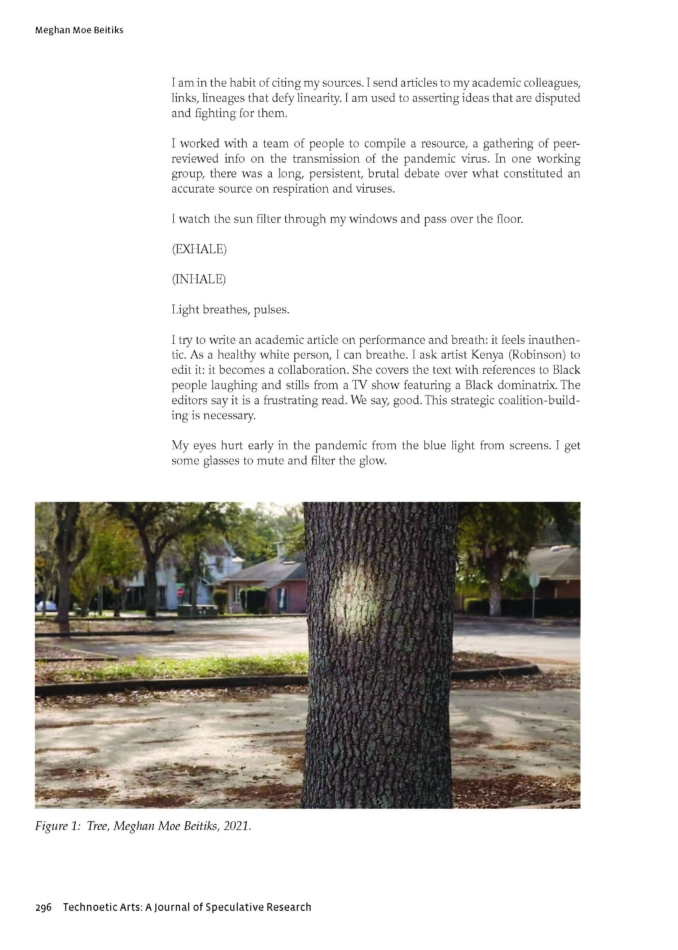
As part of a special section in an issue of Technoetic Arts called “Nestworks,” led by Amy Huestis, I wrote some musings on air, pulse and light. This paper is only part of a prolonged process with the “Nestworks” group, which began as a College Art Association panel and expanded into a dialogue of creative works amongst the members. We all presented work to each other and responded to each others’ work.
This was deep within the throes of the pandemic, and I was depleted by the persistent social violence of academia and equity battles in Florida. A number of my academic colleagues were deeply committed to limited, backward, or oppressive structures and legislations under the pretense of honouring the university’s “R1” research level status. I had utterly lost interest in articulating or validating my work within academic structures and instead wrote a piece reflecting on the emotional, political, and social processes I was going through, in the context of light and air. Please also see Breath^work, created with Kenya (Robinson).
Shut Up (2022)

Shut Up is a meditation on light and confinement. Drawing upon previous work with reflections, breath, trauma, and self-awareness, I redirect light from the NARS Foundation Project Space window with mirrors and reflective surfaces. Patterns in the space, from mirrored pixels to rotating displays to sequined pillows, are based on pixelations of the surface of the sun. A meditation on time, celestial bodies, isolation and ecologies in the pandemic.
As a closing event for the exhibition, on March 22 at 5pm, I will read an excerpt from her book Performing Resilience for Systemic Pain, recently published with Routledge, in the space as the sun sets, and discuss it friend Stephanie Acosta and visitors.



Blind Spots (2022)
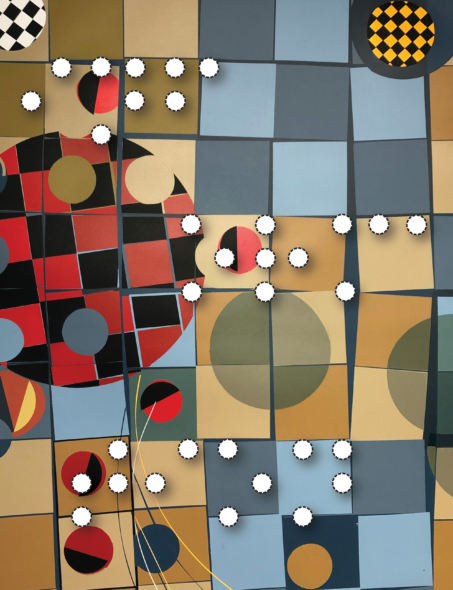
I collaborated with legally blind artist Joel Foster on a piece called Blind Spots, an interactive cutout adaptation of his paintings and process for a pandemic meditation on light and visibility.
For Performance Research, vol. 26 issue 4 On Un(Knowns). Publication date: 24 January 2022
Issue editors: Hetty Blades, Scott de Lahunta & Lucia Piquero
This issue of Performance Research explores the idea of knowledge in relation to performing arts practices. Its concern, however, is not to simply revisit academic debates about practical knowledge but to offer new contexts and insights. From academic truth claims to claims of ownership, from epistemic objects to multiple epistemologies the topic of knowledge is everywhere. This issue aims to build on the foundations laid by previous work in the field, first by attending to the knowledge generated within the performing arts — specifically the types of knowledge involved in creation, training, production, performance and spectatorship — and second by inviting further critical interrogation of what the recognition of this knowledge achieves in the frame of evolving cultural and political contexts. The issue also calls into question the use of the term in itself, interrogating methods, analysis and languaging in order to offer various conceptualizations of knowledge and the (un)known.